Hydraulic expanding mandrels: how they work, where they fit, and how to specify one
A hydraulic expanding mandrel holds a part on its bore. Turning a pressure screw pressurises oil sealed inside the mandrel body; the oil expands a thin-walled sleeve evenly around 360°, so the part is centred on its own bore and held for grinding, turning, gear work or inspection. Because every mandrel is built around a specific bore, Mongtec makes them to order.
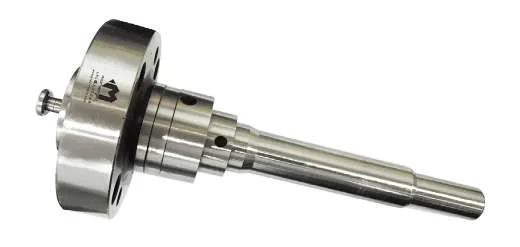
Flange-mounted Mongtec hydraulic mandrel. The pressure screw on the end face sets the clamp; each mandrel is built around the customer’s part.
How it works
Pressure screw
Turning the screw pushes a piston into a sealed oil chamber inside the body.
Expansion sleeve
The oil pressure acts on a thin-walled sleeve, which deforms elastically outward by a very small amount — evenly over its whole circumference and length.
Result
The part is centred on its bore with uniform contact, not on three or six points. Releasing the screw lets the sleeve spring back and the part comes off.
The expansion is small: the maximum expansion must not exceed 0.3–0.5% of the clamping diameter. That is what gives the accuracy, and it is also why the bore must be finished — Mongtec specifies a workpiece bore of IT7 or better on the clamping length.
Hydraulic or mechanical mandrel?
Hydraulic
Mechanical (tapered sleeve / segmented)
Clamping
Oil pressure on a continuous thin sleeve
A taper or draw bar expands a slotted sleeve or segments
Centring
Highest — uniform 360° contact
Good; depends on the segments and the taper
Expansion range
Small — 0.3–0.5% of the clamping diameter at most; one sleeve per bore size
Larger; tolerates a wider bore tolerance
Bore needed
Finished bore, IT7 or better
Can work on less accurate bores
Best for
Finishing, grinding, gear grinding, inspection
Rougher operations, wider part families
Where hydraulic mandrels are used
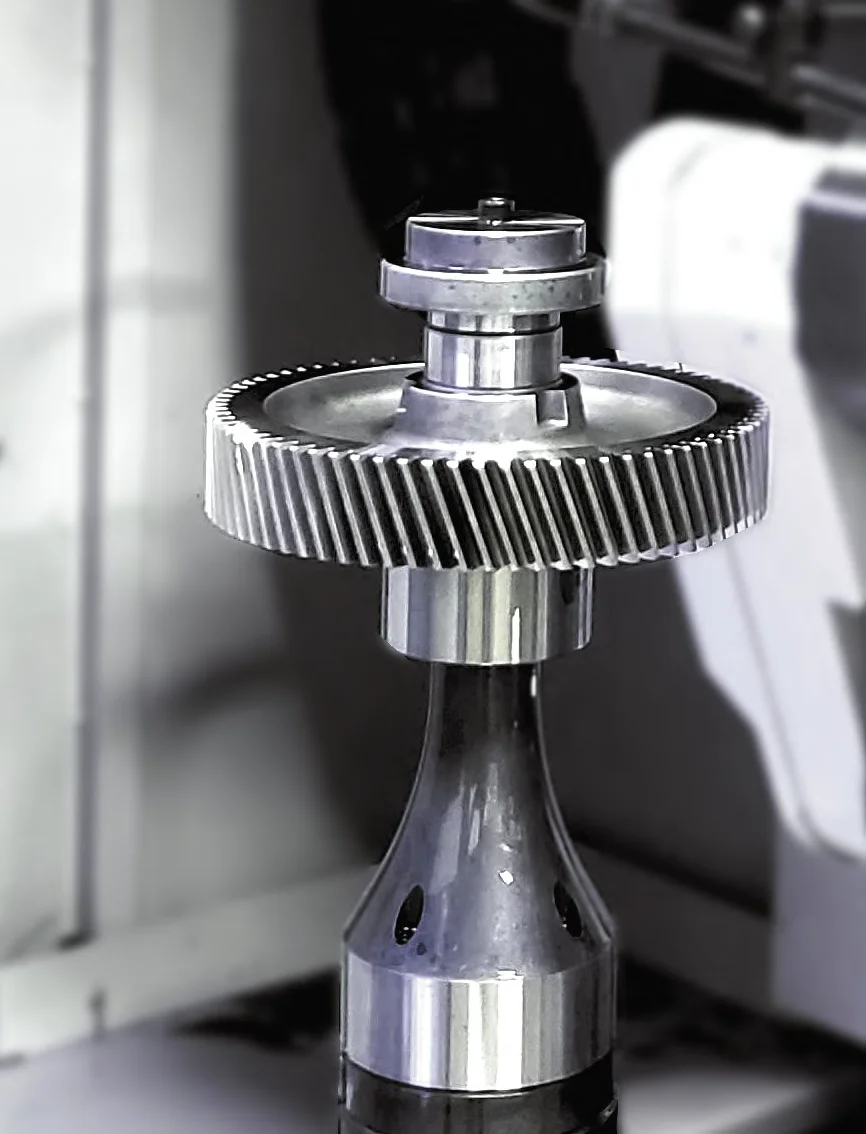
Gear grinding — the gear is located on its bore so the teeth are ground concentric to the bore that will run on the shaft.
Gear inspection — the same datum is used for measuring as for machining.
External cylindrical grinding of sleeves, bushings and rings.
Finish turning of parts that must be concentric to the bore, including thin-walled parts that distort under jaw pressure.
Interchangeable sleeves
A part family with several bore sizes does not always need several mandrels. Mongtec mandrels can be built with interchangeable sleeves on one body, so a change of bore size is a sleeve change rather than a new mandrel and a new setup.
Good practice
Never pressurise the mandrel without a part on it — the sleeve can be over-expanded and damaged.
The part should cover the clamping length. A part that sits on only part of the sleeve is held on that part only.
Keep the bore and the sleeve clean. A chip under the sleeve is runout you will measure on the part.
Tell us about interruptions in the bore — keyways, cross holes, splines — at the enquiry stage. They change the design.
What to send for a quote
Hydraulic mandrels are designed around the part, so the drawing does most of the work: the bore diameter and its tolerance, the bore length, the face the part locates against, the operation (grinding, turning, gear work, inspection), the machine and how the mandrel will be mounted (between centres, on a spindle flange or on a taper), the runout you need, and the batch size. Mongtec quotes each mandrel against that drawing.
How does a hydraulic expanding mandrel clamp a part?
A pressure screw pressurises oil sealed inside the body. The oil expands a thin-walled sleeve evenly around 360°, centring the part on its bore. Releasing the screw lets the sleeve return and the part can be removed.
How much does a hydraulic expanding mandrel expand?
Very little: the maximum expansion must not exceed 0.3–0.5% of the clamping diameter. That is why it centres so accurately, and why the part bore must be finished.
What bore tolerance does a hydraulic mandrel need?
Because the expansion is small, the part bore must be finished. Mongtec specifies IT7 or better on the clamping length.
Is a hydraulic mandrel better than a mechanical mandrel?
For finishing, grinding and inspection, yes: it centres more accurately with uniform contact. A mechanical mandrel tolerates a wider bore range and suits rougher operations.
Does Mongtec sell standard expanding mandrels from stock?
No. Mongtec builds hydraulic expanding mandrels to order around the customer's part drawing, including interchangeable sleeves where a part family has several bore sizes.