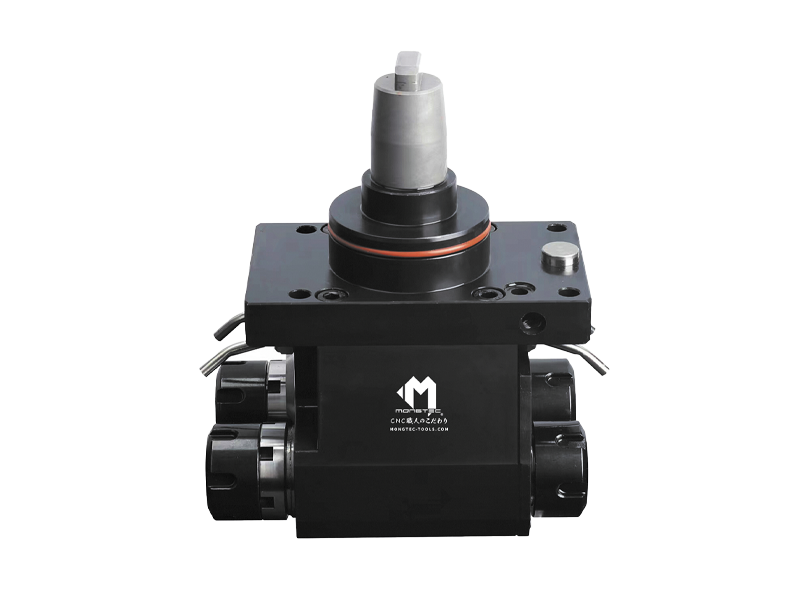
Practical notes from building driven tool holders and tool holders. Written for the person at the machine, not for a brochure. Mongtec Precision is a Taiwanese brand headquartered in Taichung, Taiwan.
| What is an angle head? A plain explanation for CNC machining centres | An angle head turns the tool axis, usually 90°, so a machining centre can drill, tap and mill side faces without re-fixturing. How it works and the main types. |
|---|---|
| Live tool vs driven tool: is there any difference? | Live tool, driven tool and rotary tool holder are the same thing: a lathe turret holder with its own driven spindle. What actually differs between two of them. |
| Driven vs static tool holders: what each one does, and how many of each you need | Static holders clamp turning tools; driven holders spin the cutter from the turret drive. How they differ and how to split a turret between the two. |
| ER collet size chart: ER8 to ER50, and how to choose the size | ER collet sizes ER8 to ER50: outside diameter, maximum clamping capacity and range per collet to DIN 6499 / ISO 15488, plus how to choose the size. |
| Hydraulic expanding mandrels: how they work, where they fit, and how to specify one | A hydraulic expanding mandrel centres a part on its bore with oil pressure on a thin sleeve. How it works, hydraulic vs mechanical, and what to send for a quote. |
| Stainless ball-joint coolant tubes: uses, advantages over plastic hose, and how to choose | What a modular stainless ball-joint coolant and air nozzle tube is, where it is used on CNC machines, how it compares with plastic hose, and how to choose bore, nozzle, adapters and length. |
| BT, BBT, CAT, SK and HSK: how the main spindle tapers differ | BT, CAT and SK share the 7/24 taper but differ in flange and pull stud; BBT adds face contact; HSK is a hollow 1:10 taper. What interchanges and what does not. |
| Live tooling brands by machine: which driven tool holders fit which turret | Builder-by-builder list of lathe turret interfaces (BMT, VDI, BOT, builder-specific) and the tooling brands that publish driven tool holders for them — confirm the turret before you order. |
| How to identify a driven tool holder | What the name plate tells you, how the mounting gives away BMT or VDI, and the five photos that make identification a same-day job — even when the plate is worn off. |
| How to cross-reference a competitor tool holder | The four things a cross-reference verifies — mounting, coupling, output geometry, duty — what is never assumed interchangeable, and exactly what to send for a like-for-like quotation. |
| Axial or radial? Choosing the driven tool holder orientation | Axial drives the cutter along the spindle axis for face work; radial turns it 90° for cross work. Where offset, retracted, double-output and adjustable types fit in. |
| How to select an angle head | Spindle interface, stop block, output angle, rating, clearance and coolant — the checks in the order that eliminates wrong options fastest, and the photo that prevents most mounting surprises. |
| BMT or VDI? How to tell which turret you actually have | BMT is an industry de-facto standard, VDI is standardised in DIN 69880. The same nominal size can differ between machine builders. Here is how to check before you order. |
| BMT turret dimensions: BMT45 to BMT85 bolt spacing chart | Centre bore, bolt spacing, screw size and key width for the five standard BMT sizes, how to measure your turret, and the builder patterns that are easy to confuse with them. |
| VDI tool holder sizes and dimensions (DIN 69880) and drive couplings | VDI16 to VDI80 shank diameter, shank length and collar size to DIN 69880, and why a driven VDI holder also needs the drive: DIN 5480, DIN 5482, DIN 1809 or builder-specific. |
| Sauter, Duplomatic or Baruffaldi turret? Which driven tool holder fits | Sauter uses DIN 5480 or DIN 5482 splines, Duplomatic a DIN 1809 tenon, Baruffaldi its own coupling. How to tell which turret is on your lathe before ordering driven tools, with machine examples. |
| PSC (Capto) or HSK-T? Choosing the tool interface for mill-turn | PSC (ISO 26623, the Capto C3 to C10 sizes) and HSK-T (ISO 12164-3) both hold turning tools in a mill-turn spindle. How they differ, what interchanges, and how to choose. |
| Weldon or whistle notch? Why the two shanks are not interchangeable | A Weldon shank has a flat parallel to the axis. A whistle notch shank has an inclined flat that pulls the tool back against the seat. They look similar and they are not interchangeable. |
| Shrink fit, hydraulic or mechanical: choosing a milling tool holder | Shrink fit gives the slimmest profile and the best runout. Hydraulic damps vibration and needs only a hex key. Mechanical is the cheapest per station. Here is when each one is the right answer. |
| Why live centers fail, and it is usually not the point | A live center normally dies from coolant in the bearing, not from a worn point. Sealing, bearing arrangement and load rating matter more than the tip you can see. |
| Face drivers: turning a shaft in one clamping | A face driver grips the end face with hardened pins so the whole shaft length is exposed. Two operations become one, with no re-clocking in between. |