Weldon or whistle notch? Why the two shanks are not interchangeable
Two side-lock shanks, two flats, and a mistake that happens in real shops: putting a whistle notch cutter into a Weldon holder, or the reverse. They are close enough to fit and different enough to matter.
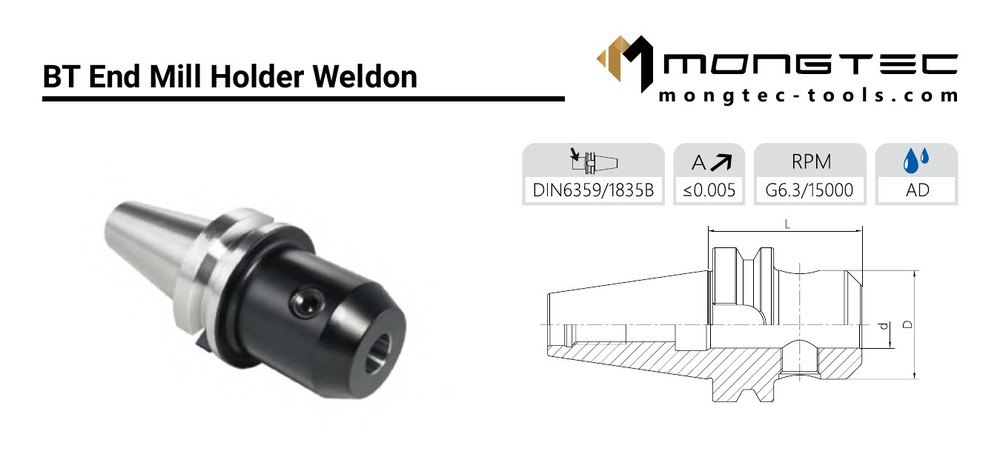
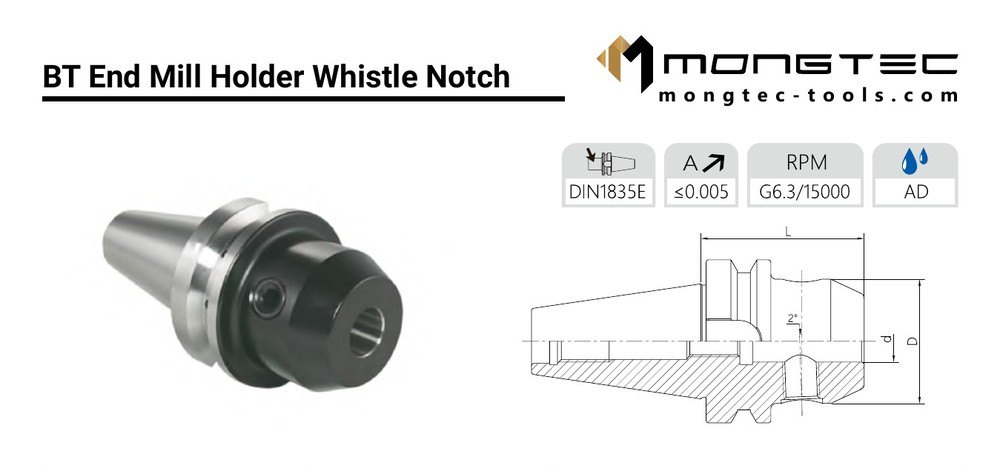
Weldon — a flat parallel to the axis, clamped by a set screw. DIN 6359 / 1835BWhistle notch — an inclined flat (2°) that pulls the tool back onto the seat. DIN 1835E
The difference in one table
Weldon, DIN 1835-B
The flat is parallel to the axis. The set screw pushes sideways onto the flat. Axial position is set by how far you push the tool in.
Whistle notch, DIN 1835-E
The flat is inclined — Mongtec cuts it at 2°. As the screw tightens it also pulls the tool back against the seat, so the axial position is defined by the holder, not by the operator.
What happens if you mix them
Whistle notch cutter in a Weldon holder: the screw contacts the inclined flat on one edge only. Contact area collapses, the screw can mark the shank, and the tool can creep out under axial load.
Weldon cutter in a whistle notch holder: the screw pushes on a parallel flat with no pull-back effect. It will hold for light work, but you lose the axial repeatability that is the reason for choosing a whistle notch in the first place.
Which to choose
Use Weldon for roughing, heavy side loads, and anywhere you want the simplest possible connection. It is the most common shank on the shop floor.
Use whistle notch when the axial position matters between tool changes — step drilling, depth-critical pocketing, or anywhere a tool creeping out by a tenth of a millimetre would scrap the part.
Mongtec range
Weldon
ø6 to ø50 mm on BT, BBT and HSK-A tapers. Coolant-through version available — the article number ends in K.
Whistle notch
ø6 to ø40 mm, flat at 2°.
Set screws
One screw up to ø20 mm; two screws from ø25 mm upward.
If you are not sure which you have
Put a straight edge along the flat. If it sits flush along the whole length, it is Weldon. If it lifts at one end, it is a whistle notch. Send us a photograph if it is borderline — we would rather check than have you receive the wrong holder.