What is an angle head? A plain explanation for CNC machining centres
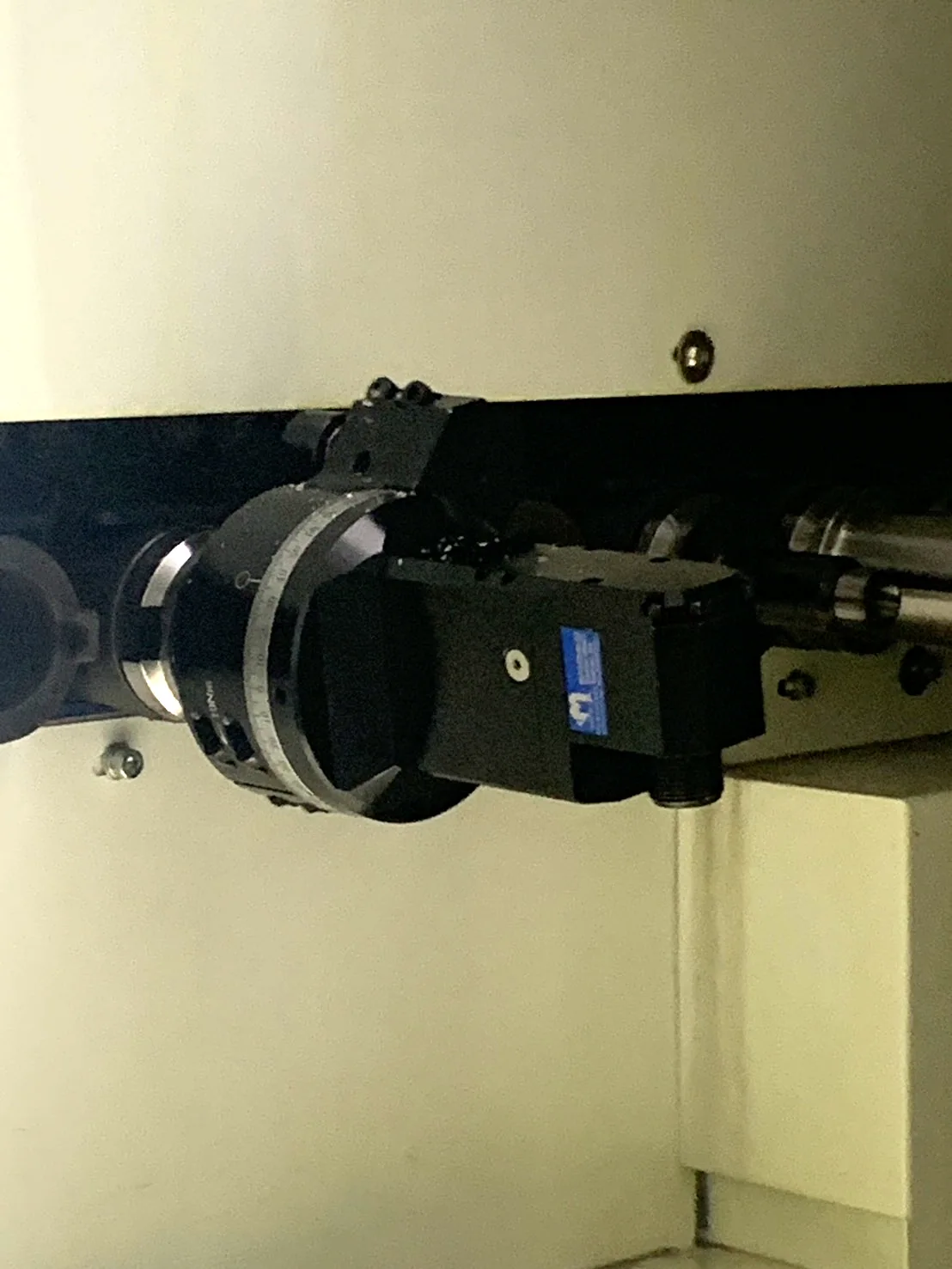
An angle head is a spindle attachment that turns the cutting tool through an angle — usually 90° — so a vertical or horizontal machining centre can drill, tap, mill and bore on faces that point sideways, without re-clamping the part or moving it to another machine. It goes into the spindle like any other tool holder and comes out of the magazine like one too.
Other names for the same thing
Right-angle head, 90-degree head, angle attachment, angular head, milling head attachment. In German it is a Winkelkopf, in Italian a testa angolare, in Spanish a cabezal angular, in Japanese an アングルヘッド and in Chinese 角度頭 / 角度头. They all mean the same device. A speeder or speed increaser is a different attachment: it raises the rpm but keeps the tool on the spindle axis.
How it works
Input
A taper shank — BT, CAT, SK or HSK — that clamps in the machine spindle exactly like a normal tool holder, with the same pull stud.
Gearing
Inside the housing a bevel gear pair transfers the spindle rotation through the angle. Most heads run 1:1; speed-increasing and speed-reducing ratios exist for small drills or for torque.
Stop block
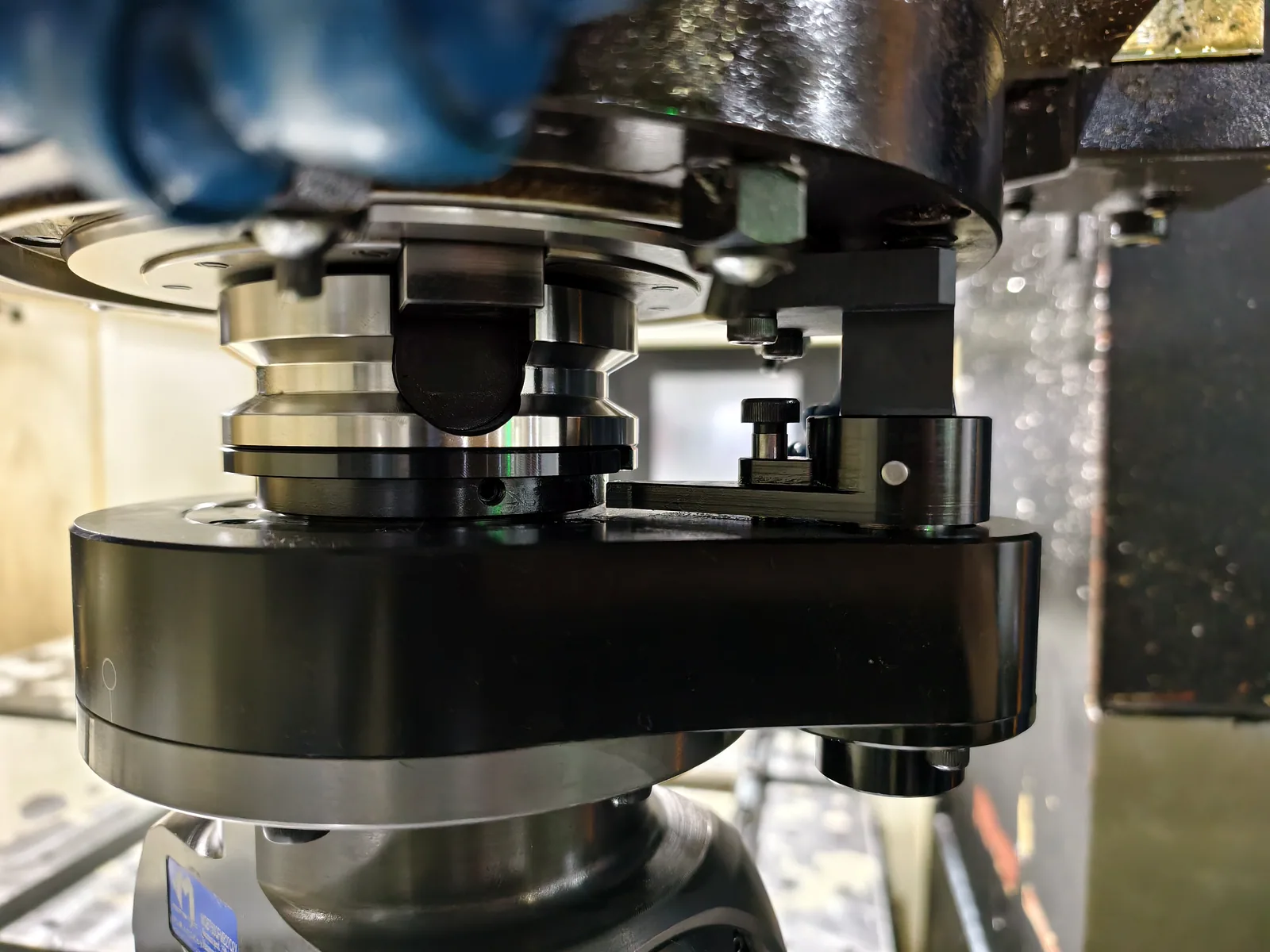
The housing must not turn with the spindle. A torque arm on the head locates against a stop block or stop pin on the spindle nose, so only the internal shaft rotates. This is the part that is specific to each machine.
Output
The output spindle carries the cutter: an ER collet, a DC chuck, a face-mill arbor, or a second tool-holder taper on heavier heads.
The torque arm seated against the machine stop block. If this does not match the spindle nose, the head cannot be mounted — it is the first thing Mongtec checks.
The main types
Fixed 90°
The standard head and the stiffest. Covers most cross drilling, side tapping and side milling.
Fixed other angles
30°, 45° or 55° heads for features that are inclined but always at the same angle — a fixed head is stiffer than an adjustable one set to that angle.
Adjustable (0–90°)
One head for several angles, set by a graduated scale. More flexible, less rigid, and the angle must be checked after every change.
Multi-output
Two or four outputs on one body, so one head reaches opposite faces or runs two tools without a tool change.
Slim or extended nose
A narrow, long body for deep cavities and bores where a standard head body would hit the part or the fixture.
Face-mill output
A heavy head with an arbor output (FMB) for side face milling. This is where torque, not speed, decides the size.
Angle head, second setup or 5-axis?
Angle head
Best when the side features sit at fixed angles, the batch is small to medium, and the machine is already a capable 3-axis or horizontal. One attachment, no new machine, no second fixture.
Second setup
Cheap in equipment, expensive in time: another fixture, another handling step, and a datum transfer that costs accuracy between the two sides.
5-axis machine
Right when the part needs continuously changing tool angles or five faces in one setup every day. A large investment to make for a handful of cross holes.
What to read on an angle head datasheet
Spindle interface and pull stud — taper size and the exact pull stud the machine uses.
Maximum speed and torque — the head, not the machine, limits the cut. Plan the operation on the head’s continuous rating.
Ratio — 1:1, increasing or reducing.
Output — collet size or arbor, which sets the largest cutter.
Nose dimensions — the distance from the spindle axis to the cutter tip and the width of the body, which decide whether the head clears the part.
Weight and ATC — whether the head is within the tool changer’s weight and diameter limits.
Coolant — external nozzle or through-the-head.
Mongtec angle heads
Mongtec publishes 137 angle head models on BT30, BT40 and BT50 shanks, up to 12,000 rpm and 200 Nm, with ER11 to ER40 collet, DC5 to DC16 chuck, FMB22 and FMB27 arbor and BT40 tool-holder outputs. HSK-A63, HSK-A100, NT, SK and CAT shanks are available on selected models, and any model can be built to order with a different reach, angle, output or stop arrangement. Browse the angle head range →
Is an angle head the same as a right-angle attachment?
Yes. Angle head, right-angle head, 90-degree head and angle attachment all describe a spindle attachment that turns the tool axis. A speed increaser is different: it raises rpm but keeps the tool on the spindle axis.
Can an angle head be loaded by the automatic tool changer?
Many can, if the head is within the changer's weight and diameter limits and the stop block orientation allows automatic pickup. The machine model and magazine type are enough to confirm it.
Does an angle head reduce the power available at the cutter?
The machine spindle still drives it, but the head has its own maximum speed and torque rating. The cut has to be planned on the head's rating, which is lower than the spindle's on most machines.
When is an angle head better than buying a 5-axis machine?
When the side features are at fixed angles, the batch is small to medium and the machine you have is otherwise capable. If the part needs continuously changing angles or five faces in one setup every day, a 5-axis machine is the better investment.