How to select an angle head
An angle head turns one machining centre into two — but it must match the machine on five independent points at once. These are the checks in the order that eliminates options fastest.
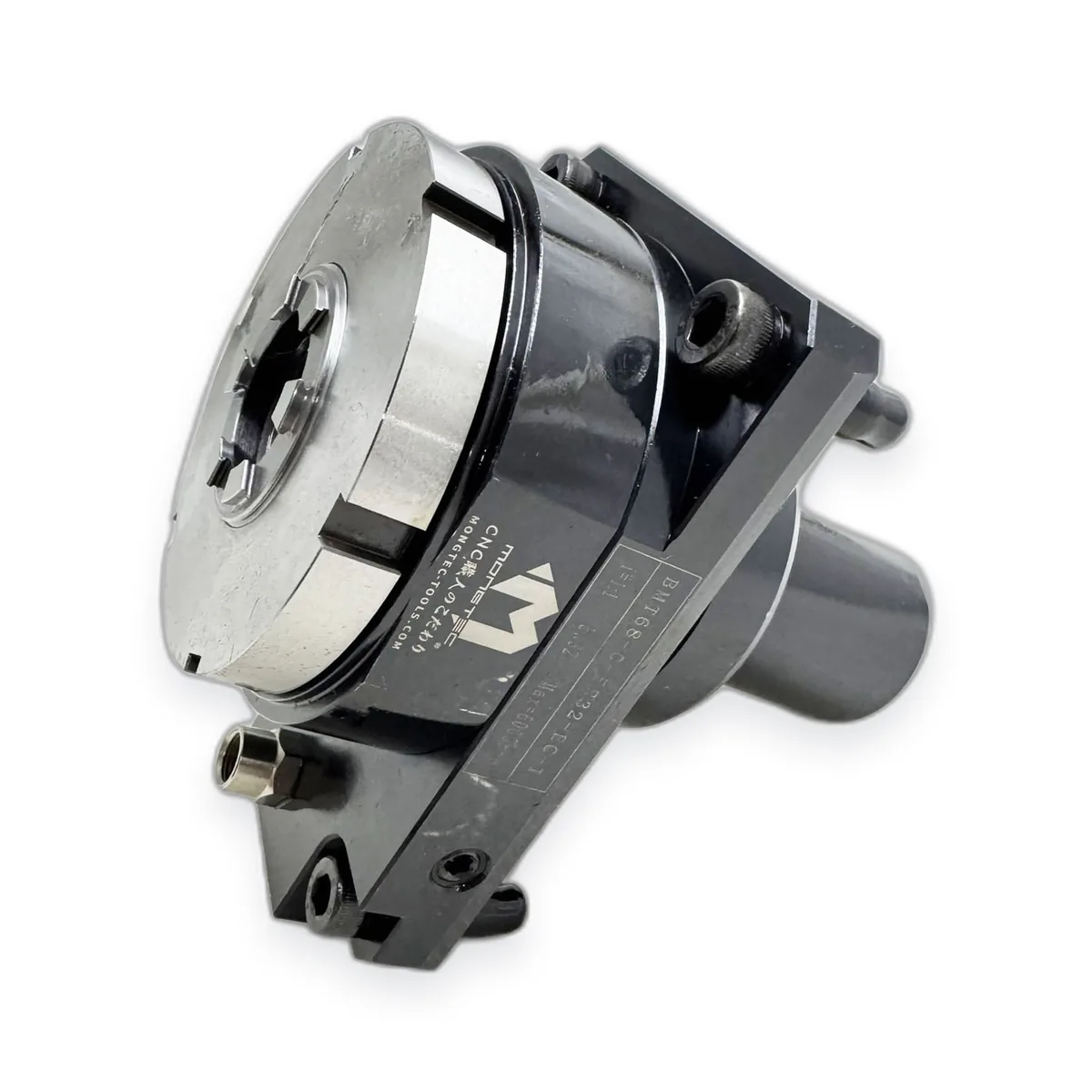
An angle head turns one machining centre into two — but it must match the machine on five independent points at once. These are the checks in the order that eliminates options fastest.
BT30/40/50, CAT40/50, SK, HSK-A63/A100 — the taper must match, and so must the pull stud. This is on the machine’s spec sheet; when in doubt, the machine model is enough for us to confirm it. Browse angle heads by spindle interface.
The angle head’s torque arm locates against a stop block on the spindle nose. Machines differ; heads ship with adjustable or machine-specific blocks. A photo of the spindle nose answers this in one step — this is the check most often skipped, and the most common cause of a head that arrives and cannot be mounted.
Fixed 90° covers most work. Adjustable heads (0–90°) buy flexibility at some cost in rigidity. Then the geometry: will the head body clear the fixture and the part at the feature you need to reach? Protrusion and body diameter against your fixture layout — a rough sketch is enough for a clearance check.
The head’s continuous rating must cover the operation, not the machine’s spindle maximum. Gear ratio matters twice: output speed, and the torque available at low rpm for tapping and larger drills.
ER collet sizes on the output, and how coolant reaches the cut — external nozzles, or through-head where the machine supports it.
Machine make and model, the feature you need to reach (a drawing section or photo), the cutter you plan to run, and a photo of the spindle nose. Mongtec engineering confirms the interface, stop block and clearance before anything is quoted.
Send the machine model and a spindle nose photo — reply within one working day →