An ER collet clamps by squeezing a short slit sleeve. A power milling chuck clamps a long, plain cylinder through a needle-roller mechanism that converts nut torque into a large, evenly distributed radial force over a much longer contact length.
The difference shows up under side load, which is what roughing actually applies. A collet resists the tool being pulled out; a milling chuck resists the tool being levered sideways. That is why the milling chuck is the standard choice for high-feed roughing, deep slotting, and any operation where the cutter is trying to walk out of the holder rather than simply spin in it.
HC is the compact series: Ø20–42 mm capacity in body lengths from 80 to 300 mm, with the clamping range printed as two figures (for example 3–25 / 32) because reduction sleeves extend the chuck below its nominal size.
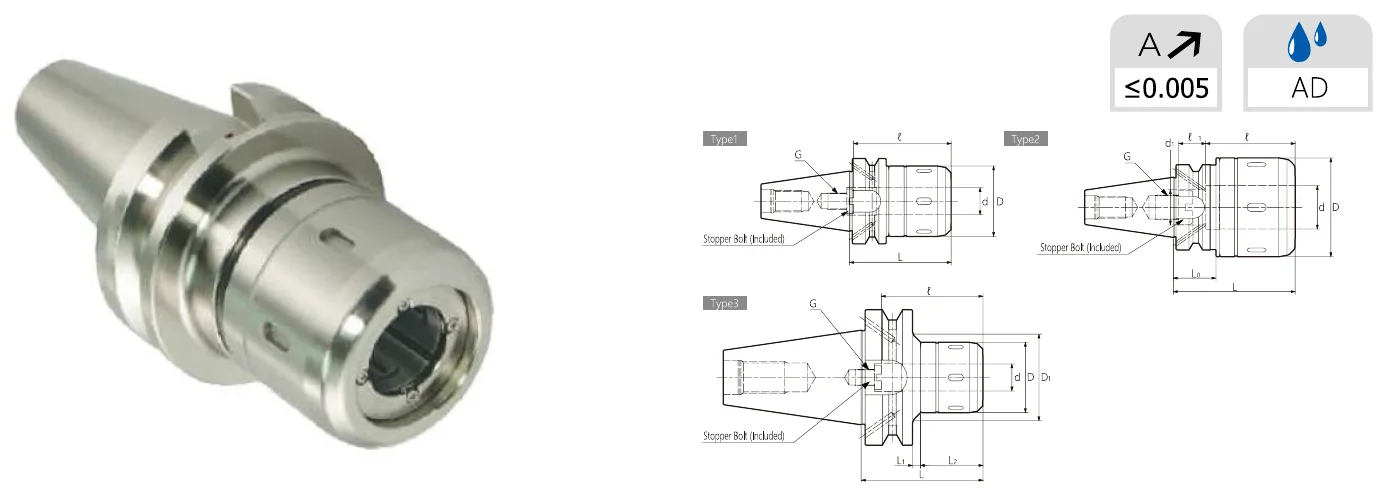
CT is the long-reach series, Ø16–42 mm, catalogued in three body types and in lengths to 450 mm on BT50. This is the family for reaching into a deep cavity while still taking a real cut — the extra dimensions in the table (L1, L2, ℓ, ℓ1, ℓ2, d1, L0) describe the stepped nose that gets the body out of the way near the cutting end.
A milling chuck is heavier and bulkier than a collet chuck at the same capacity, and it is slower to change tools in. It also has a nose diameter that will foul work a slim collet chuck would clear. Use it where the cut justifies it, and keep collet chucks for everything else.
Dimension symbols are the catalogue's own and refer to the dimension drawing printed for each product. A dash means the catalogue does not print a usable value for that cell; those are confirmed in writing at RFQ. Where a table's printed header disagrees with its drawing, a note above the table says so.
| Article no. | d | D | L | Capacity |
|---|---|---|---|---|
| BT30QHC20Q80 | 20 | 50 | 80 | 3-16 / 20 |
| BT30QHC25Q90 | 25 | 59 | 90 | 3-20 / 25 |
| BT30QHC32Q110 | 32 | 72 | 110 | 3-25 / 32 |
| BT40QHC20Q90 | 20 | 50 | 90 | 3-16 / 20 |
| BT40QHC25Q100 | 25 | 59 | 100 | 3-20 / 25 |
| BT40QHC32Q90 | 32 | 72 | 90 | 3-25 / 32 |
| BT40QHC32Q105 | 32 | 72 | 105 | 3-25 / 32 |
| BT40QHC32Q165 | 32 | 72 | 165 | 3-25 / 32 |
| BT40QHC42Q130 | 42 | 99 | 130 | 3-32 / 42 |
| BT50QHC20Q105 | 20 | 50 | 105 | 3-16 / 20 |
| BT50QHC25Q105 | 25 | 59 | 105 | 3-20 / 25 |
| BT50QHC32Q110 | 32 | 72 | 110 | 3-25 / 32 |
| BT50QHC42Q110 | 42 | 99 | 110 | 3-32 / 42 |
| BT50QHC32Q165 | 32 | 72 | 165 | 3-25 / 32 |
| BT50QHC32Q200 | 32 | 72 | 200 | 3-25 / 32 |
| BT50QHC32Q250 | 32 | 72 | 250 | 3-25 / 32 |
| BT50QHC32Q300 | 32 | 72 | 300 | 3-25 / 32 |
| Article no. | Type | d | D | D1 | L | L1 | L2 | ℓ | ℓ1 | ℓ2 | d1 | L0 | G |
|---|---|---|---|---|---|---|---|---|---|---|---|---|---|
| BT30QCT16SAQ90 | 1 | 16 | 45 | — | 90 | — | — | 65 | — | 15 | — | — | M10 |
| BT30QCT20SAQ90 | 2 | 20 | 52 | — | 90 | — | — | 80 | — | 15 | — | 40 | M12 |
| BT30QCT25SAQ90 | 2 | 25 | 61 | — | 90 | — | — | 80 | — | 15 | — | 31 | M12 |
| BT30QCT32SAQ90 | 2 | 32 | 68 | — | 90 | — | — | 68 | — | 20 | — | 30 | M18 |
| BT40QCT16SAQ90 | 1 | 16 | 45 | — | 90 | — | — | 65 | — | 15 | — | — | M10 |
| BT40QCT20SAQ90 | 1 | 20 | 52 | — | 90 | — | — | 80 | — | 15 | — | — | M12 |
| BT40QCT25SAQ90 | 1 | 25 | 61 | — | 90 | — | — | 80 | — | 15 | — | — | M12 |
| BT40QCT25SAQ105 | 1 | 25 | 61 | — | 105 | — | — | 80 | — | 15 | — | — | M12 |
| BT40QCT32SAQ90 | 2 | 32 | 73 | — | 90 | — | — | 76 | 32 | 17 | 26 | 31 | M18 |
| BT40QCT32SAQ105 | 2 | 32 | 73 | — | 105 | — | — | 85 | 23 | 17 | 26 | 44 | M18 |
| BT40QCT32SAQ135 | 2 | 32 | 73 | — | 135 | — | — | 120 | — | 17 | — | 74 | M18 |
| BT50QCT16SAQ90 | 3 | 16 | 45 | 58 | 90 | 7 | 45 | 65 | — | 20 | — | — | M10 |
| BT50QCT20SAQ90 | 3 | 20 | 52 | 65 | 90 | 7 | 45 | 80 | — | 15 | — | — | M12 |
| BT50QCT20SAQ105 | 3 | 20 | 52 | 70 | 105 | 9 | 58 | 80 | — | 15 | — | — | M12 |
| BT50QCT20SAQ135 | 3 | 20 | 52 | 73 | 135 | 39 | 58 | 80 | — | 15 | — | — | M12 |
| BT50QCT20SAQ165 | 3 | 20 | 52 | 73 | 165 | 69 | 58 | 80 | — | 15 | — | — | M12 |
| BT50QCT25SAQ105 | 3 | 25 | 61 | 82 | 105 | 11 | 56 | 80 | — | 15 | — | — | M12 |
| BT50QCT25SAQ135 | 3 | 25 | 61 | 83 | 135 | 41 | 56 | 80 | — | 15 | — | — | M12 |
| BT50QCT25SAQ165 | 3 | 25 | 61 | 86 | 165 | 71 | 56 | 80 | — | 15 | — | — | M12 |
| BT50QCT32SAQ105 | 1 | 32 | 73 | — | 105 | — | — | 120 | — | 20 | — | — | M18 |
| BT50QCT32SAQ135 | 3 | 32 | 73 | 88 | 135 | 41 | 56 | 120 | — | 20 | — | — | M18 |
| BT50QCT32SAQ165 | 3 | 32 | 73 | 86 | 165 | 71 | 56 | 120 | — | 20 | — | — | M18 |
| BT50QCT32SAQ200 | 3 | 32 | 73 | 88 | 200 | 106 | 56 | 120 | — | 20 | — | — | M18 |
| BT50QCT32SAQ250 | 3 | 32 | 73 | 88 | 250 | 156 | 56 | 120 | — | 20 | — | — | M18 |
| BT50QCT32SAQ300 | 3 | 32 | 73 | 88 | 300 | 206 | 56 | 120 | — | 20 | — | — | M18 |
| BT50QCT32SAQ350 | 3 | 32 | 73 | 88 | 350 | 256 | 56 | 120 | — | 20 | — | — | M18 |
| BT50QCT32SAQ400 | 3 | 32 | 73 | 88 | 400 | 306 | 56 | 120 | — | 20 | — | — | M18 |
| BT50QCT32SAQ450 | 3 | 32 | 73 | 88 | 450 | 356 | 56 | 120 | — | 20 | — | — | M18 |
| BT50QCT42SAQ105 | 1 | 42 | 88 | — | 105 | — | — | 120 | — | 20 | — | — | M18 |
| BT50QCT42SAQ135 | 1 | 42 | 88 | — | 135 | — | — | 120 | — | 20 | — | — | M18 |
| BT50QCT42SAQ165 | 1 | 42 | 88 | — | 165 | — | — | 120 | — | 20 | — | — | M18 |
| BT50QCT42SAQ200 | 1 | 42 | 88 | — | 200 | — | — | 120 | — | 20 | — | — | M18 |
| BT50QCT42SAQ250 | 1 | 42 | 88 | — | 250 | — | — | 120 | — | 20 | — | — | M18 |
| BT50QCT42SAQ300 | 1 | 42 | 88 | — | 300 | — | — | 120 | — | 20 | — | — | M18 |
The drawing above is the published catalogue drawing, and the dimension letters are the columns of the table below. What Mongtec confirms for you is the interface on your machine, the reach for the operation, and the final article number. Send the machine and the operation; the check is free.
Send my machine and get the article number →Source: Mongtec BT·BBT Tooling System catalogue, Ver 2026.
Yes — that is the point of it. It grips the cylindrical shank over a long length rather than locking against a flat, so it is both positive and concentric.
The chuck is nominally a 32 mm chuck; with reduction sleeves it clamps down to 3 mm. Order the sleeves for the shank diameters you actually run and quote them with the holder.
A milling chuck for roughing — it takes more side load. A hydraulic chuck for reaming, boring and finishing — it damps vibration and runs truer. They are complements, not alternatives.